




For many women, a diagnosis of polycystic ovary syndrome (PCOS) has come with more confusion than clarity.
The name itself has long implied something it does not quite represent, and for the estimated one in eight women living with the condition, that gap between name and reality has too often meant delayed diagnoses, fragmented care, and unanswered questions.
That is now beginning to change.
What is PCOS or PMOS, and why is it being renamed?
Recent news just revealed that the condition is undergoing a significant rename. A paper published in The Lancet has proposed changing the name to polyendocrine metabolic ovarian syndrome, or PMOS.
It is important to understand that this change reflects a growing understanding that the condition extends well beyond the ovaries, and accurately captures its hormonal and metabolic complexity.
What does PMOS mean?
The transition from PCOS to PMOS is designed to reduce the misunderstandings that have historically led to missed or delayed diagnoses.
While a diagnosis is still generally made when at least two of three criteria are present — irregular periods, elevated androgen levels, and a particular ovarian appearance — the term PMOS better describes the root causes:
Polyendocrine: Affecting multiple hormone systems.
Metabolic: Impacting insulin, blood sugar, and weight.
Ovarian: Acknowledging the reproductive involvement.
Is hair loss a symptom of PMOS?
Yes — hair thinning is a recognized and well-documented symptom of PMOS.
Because androgens directly influence how hair follicles behave, elevated androgen levels (the "polyendocrine" aspect of the name) may disrupt the normal hair growth cycle. For some women, visible thinning may be one of the earliest signs that a hormonal and metabolic imbalance is present.
PMOS and hair loss are more closely connected than many women realize — and the scalp may reflect what is happening hormonally long before other symptoms become apparent.
How PMOS causes hair loss
The recent news emphasizes that PMOS is a multisystem disorder. This means your hair loss isn't just a "cosmetic" issue — it is often a visible indicator of your body's internal metabolic and endocrine health.
The mechanism behind PMOS-related hair loss is driven by hormonal imbalances—specifically, elevated levels of androgens like testosterone and its potent byproduct, DHT.
Androgens can shorten the active growth phase of the hair cycle, which over time may result in strands that become progressively finer and shorter. This can show in follicle miniaturization, which is a process where the hair follicle progressively shrinks, thus producing strands of hair that are thinner, weaker, more prone to breakage and whose roots originate less deeply. This results in thinning that tends to be most visible along the crown and mid-scalp.
Over time, without intervention, affected follicles become increasingly dormant.
This is a scalp-level issue as much as a hormonal one, which is why the condition of the scalp itself may play a meaningful role in how follicles respond.
What the research shows
A study found that among 472 women diagnosed with female pattern hair loss, approximately 8% were already living with a known PCOS diagnosis (now known as PMOS).
An additional 15 were referred to a hormone specialist based on observations made during their hair and scalp consultation alone — and of those 15, 12 received a confirmed PCOS diagnosis, in many cases for the first time.
This suggests that for some women, a hair and scalp appointment may be the first step toward identifying an underlying hormonal condition that had previously gone undetected.
Signs that may indicate PMOS-related hair loss
Certain signs observed alongside hair thinning may warrant further hormonal investigation. These may include:
- Irregular or absent menstrual cycles
- Metabolic markers like unexplained weight gain or "brain fog"
- Excess facial or body hair growth
- Scalp changes, including increased oiliness or inflammation
- Acne, particularly along the jawline
- Darkening of skin in body folds, known as acanthosis nigricans
Importantly, the research found that hormone blood tests were not required to confirm a PMOS diagnosis in any of the reviewed cases — meaning careful clinical observation and a thorough personal history may be more immediately useful than laboratory results alone.
Managing PMOS Hair Loss
For women navigating PMOS and hair loss, pharmaceutical interventions are not the only option.
With the new focus on metabolic health, managing PMOS symptoms like hair loss requires a holistic approach. By addressing insulin resistance and hormonal surges, you can create a better environment for hair health.
Combined with scalp-first strategies, you can proactively manage the progressive thinning often associated with this "breakout" diagnosis.
Daily scalp care
A balanced, healthy scalp may help maintain an environment in which follicles are better supported, even under hormonal pressure. A scalp-first approach is among the most evidence-aligned strategies available.
In order to fully support your scalp, we believe that thorough, regular cleansing is crucial for your daily hair health. Make sure that if you shampoo daily, use gentle cleansers to prevent scalp dryness and itchiness.
If you can’t wash your hair every day, aim for every other day.
Nutrition
Certain vitamins and minerals are essential for healthy hair growth. Iron, zinc, vitamin D, and B vitamins are commonly deficient in women with PMOS, and each may compound hair thinning.
A diet that supports hormonal balance and reduces systemic inflammation may serve as a meaningful complement to any topical regimen.
Some research suggests that certain supplements, including inositol and omega-3 fatty acids, may also support hormonal regulation in women with PMOS. These options are worth discussing with a qualified healthcare provider.
Stress management
Chronic stress elevates cortisol, which may further disrupt hormonal balance and accelerate shedding. In fact, stress can trigger hair loss in several different ways—either through autoimmune disorder, temporary shedding, or trichotillomania (hair-pulling disorder).
Practices that support nervous system regulation can indirectly benefit hair and scalp health over time.
Why the scalp may signal systemic health
The scalp is not simply the foundation for hair, it may be a reflection of what is happening within the body.
The hair follicles are one of the most metabolically active areas of the body, and they’re usually one of the first indicators of a problem that extends beyond the scalp.
Our hair specialists who take a thorough, individualized approach that includes a detailed personal history, are sometimes among the first to observe patterns that point toward underlying hormonal or metabolic imbalances.
For women experiencing unexplained thinning alongside other androgen-related signs, this kind of attentive, science-informed assessment may be genuinely consequential.
How to deal with PMOS hair loss
Managing PMOS-related hair loss may involve addressing both the hormonal environment and the condition of the hair and scalp itself, ideally in parallel.
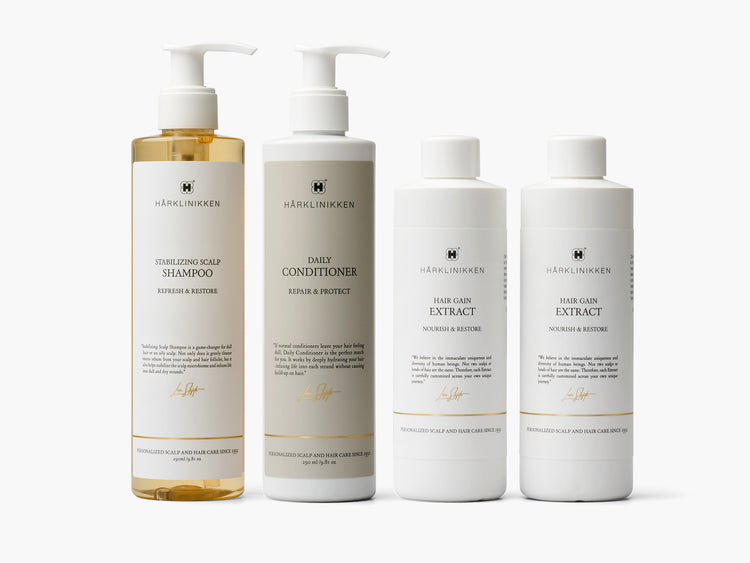
If you’re seeking a gentle, drug-free solution, the Hårklinikken Hair Gain Extract was awarded the Best Treatment for Thinning Hair by Marie Claire. Powered by plant-based ingredients that work in unique synergy, it is customized to each individual's needs and continuously adjusted throughout the treatment based on compliance and response. It has been clinically proven to optimize conditions for hair growth for those dealing with hair loss related to hormonal imbalance, stress, environmental factors, and more.
Each bottle is formulated for the individual, drawing on over 33 years of research and the expertise of founder Lars Skjøth and his clinical findings from more than 100,000 clients.
For women navigating PMOS-related hair thinning, a personalized, clinically studied approach may offer a meaningful path forward, one that works alongside medical care rather than in place of it.
If you suspect your hair thinning may be connected to hormonal factors, seeking evaluation from both a hair specialist and your primary care provider or OB-GYN may be a valuable first step.
This article is intended for informational purposes and does not constitute medical advice. Please consult a qualified healthcare provider for any concerns related to PMOS or hormonal health.
